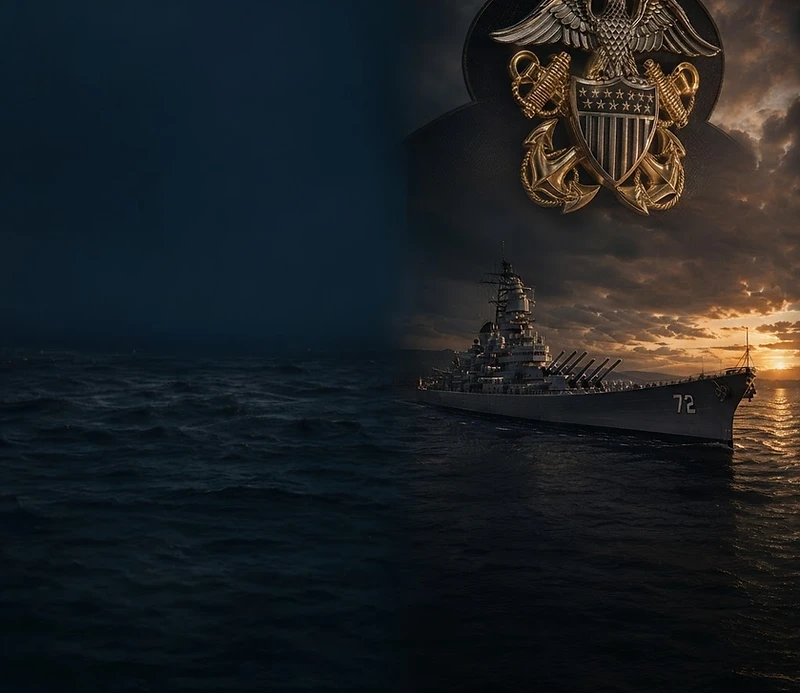
Book cover
A Novel · Clovercroft Publishing

Quarterdeck Justice

At sea, the line between duty and justice is drawn in salt and steel.

To be released November 2026

The Manuscript

Leaf through selected passages.

1 / 3
Reactivation
Reactivation

History, like war, has its own strange logic. In the end, it was not a sudden burst of patriotism that revived Columbia; instead, it was a spreadsheet. The numbers men in the Pentagon, hunting for a cheap symbol of strength, noticed her name buried in the Register of Ships, and with Reagan's naval buildup to a 600-ship fleet to counter the Soviets, they needed battleships, something grand—something with armor, a story, and just enough nostalgia to sell a generation on the idea of American power reborn. Once again, the Iowas were called back. Columbia would sail again, recommissioned as the last of the great sisters, more powerful than the ship she had once been.

Reactivation was a spectacle: News crews filmed the first welders hacking away at her superstructure. Contractors arrived by the hundreds, some young enough to have never seen a battleship, and they gawked at the size of her boilers, the gunmetal labyrinth of her magazines, and the thickness of her armor. The modernizations came in like a tidal wave of change. Columbia's analog fire control was reconditioned like new; her old search radars were swapped with modern sets of twice the range; some of her secondary mounts made way for Tomahawk missile launchers, the clunky geometry of Harpoon canisters, and 20mm Close-In Weapon System (CIWS) mounts. In her new configuration, Columbia was an artifact wrapped in cordite and circuit boards—a paradox of analog muscle and digital brain.

The work was meticulous, almost reverent. Each bolt and valve was tested, each hatch refitted with the care of a museum restoration. The old-timers—some of them the men who had watched her slumber in the rain—walked the decks and grumbled about the changes, but even they could not help but feel a pulse of pride as her hull was repainted and her numbers freshly restenciled. In the shipyard, she cut an unmistakable silhouette against the smog and haze of Long Beach.

By the spring of 1989, Columbia was tied up at Pier 6. She was a living contradiction: her armor designed to shrug off shells that no one made anymore, her magazines loaded with ordnance half a century old, and her smart missiles not yet tested in war. Her engines, overhauled but fundamentally unchanged, could still propel her to thirty-two knots if you didn't mind the vibrations back aft. Her crew quarters—modernized to modern standards—were a maze of linoleum, fluorescent light, and a baffling mixture of new and antique Navy-issue gear.

The base itself had changed, too. Terminal Island was no longer mud and promise, but a modern base and naval shipyard. Every morning, the scent of diesel exhaust and ocean brine mixed with the fresh paint and hiss of the steam lines on the pier. Navy men, most born long after her first decommissioning, moved to their duty stations with the distracted discipline of an all-volunteer force. There was pride, but it was quieter, more procedural—a checklist to be completed before evening liberty.

Columbia's status was both ceremonial and strategic. She represented a statement—America's ability to project strength through sea power with iron and determination—but she also made the Pentagon nervous. The world had changed; nuclear submarines, carrier strike groups, and bombers did the heavy lifting now. A battleship was a blunt instrument in an age of scalpels and satellite-guided death.
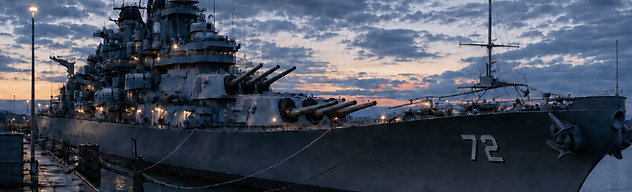
The Quarterdeck
The Quarterdeck

The Chris-Craft's bow slowly sliced the bay like it belonged there, but Jay could feel a wrongness. He never claimed to be psychic, but he felt an unspoken intention in every inch the hull stole toward the forbidden line.

He held the lifeline and let the chill of the steel wire bleed into his palms, focusing on the vessel's approach with a clarity that tasted almost metallic. He ticked off the warning steps in his mind—things that the security course had suggested, each escalation ratcheting the pressure another notch up the chain. The only thing he hated more than confrontation was fucking up a situation.

He turned to the Boatswain's Mate of the Watch, voice measured and precise. "Boats, bring the 1MC online, topside speakers only. Issue a warning to the civilian boat approaching the restricted area. Phrase it as per the book."

The BOOW responded instantly, peeling away to the quarterdeck shack, grabbing the binder containing all of the standard announcements. He flipped quickly through it, found the page he was looking for, and fumbled the 1MC's mic from its bracket. Jay watched the man's hands; they shook only a little, but it was enough to register as a warning of its own.

"Civilian boat, this is the United States Navy warship at Pier 6. You are approaching a restricted area. Alter course immediately or you will be subject to security actions."

The sound carried with surprising force, bouncing off the water and echoing down the length of the hull. Boats had done perfectly. Jay had initially thought to do it himself, but it was the young petty officer's job, and Jay knew that his job was to keep the big picture.

Jay glanced at the quarterdeck lectern where FC2 Ames recorded the time, then the warning, in a hand so practiced it was nearly calligraphic. Each line in the log was a knot, tying Jay to the precise consequences of his actions.

No response from the Chris-Craft. The boat kept to its course, not fast but steady, somewhat low in the water, ignoring the orange buoys and the very concept of caution. Jay watched it like a clock, waiting for a stutter, a course correction, any sign of intent besides steady stupidity.

"Ames," he called, "you log that?"

"0907, verbal warning issued to civilian vessel, no response seen," Ames replied.

"Boats, repeat the warning," Jay said.

The 1MC's message was sharper this time, the syllables almost clipped by wind. Jay's scalp prickled with the sense of being watched—not by the Chris-Craft, which was now less than two football fields away, but by the invisible network of responsibility above and below him. He could picture the CO, probably at the golf course now, being notified by pager if Jay got this wrong. He would not get it wrong.

"Boats," Jay said, "On the 1MC. All circuits, standard language. Security alert, unauthorized vessel approaching portside. Then pass CDO to the quarterdeck."

"Aye, aye, sir!" Boats was doing well, staying calm. The click of the mic, then, "Security alert, security alert. All hands stand fast. Away the Marines! Reason for security alert: unauthorized vessel approaching the port side. Command Duty Officer, your presence is requested on the quarterdeck."

Jay felt the sequence engage, each man in his station performing as if a larger and more ancient intelligence was pulling their strings. It was the only thing that made him feel safe, that thick rope of routine stretching back to every watch he'd ever stood, every officer who'd ever looked out over the water and speculated about what the hell was coming. Everyone on the ship now knew that something was on and would be wondering, especially during a Sunday morning. Jay knew he was committed now to at least some questions after this.

He watched as the Chris-Craft passed the last buoy in the line, its wake bumping it aside with a soft thunk that somehow echoed across the channel. The man at the wheel—Jay could now see it was a man, older, wearing a battered Dodgers cap—never looked up, never even glanced at the ship.

That, more than anything, made the hair on Jay's neck stand on end.

The Investigation
The Investigation

Hospital rooms had a way of reducing people to living machines: a collection of lines, tubes, and crosshatched bruises arranged on white.

Jay lay flat, left leg elevated and bracketed by a metal cage, right arm bandaged from wrist to elbow. The world had condensed to the slow drip of fluids and the low hum of air-conditioning, punctuated by the occasional rattle of a cart or a nurse checking vitals. He'd stopped trying to keep track of time; the morphine wiped out the numbers and left him with only the sensory fragments of each passing hour.

He thought at some point Captain Hsu, Columbia's Commanding Officer, came in. At least he remembered some conversation, or was it a dream? He wasn't sure. Jay was fairly sure the Captain had said something to him, a short formal speech about heroism and duty and his undiminished pride, but most of the words drifted away the instant they were spoken.

Somewhere in the rolling gray static of his thoughts, Jay registered a new set of footsteps. Not the scuffed, functional shoes of the nursing staff, or the soft rubber of the orderlies. These were crisp, clicking, measured—each step pronounced and evenly spaced. He tried to focus, to marshal himself into awareness as the footsteps drew closer. The morphine, uncooperative, dragged him sideways instead.

The woman who entered his room made the rest of the hospital seem even more threadbare than it already was. She wore khakis, cut and pressed so sharply that it looked like a threat in textile form. Her blouse was starched enough to resist gravity, the collar riding perfectly at her throat, and the insignia were polished to the standard of a jeweler's showcase. Just about Jay's height, her femininity was not obscured by her uniform. Her blonde hair was pulled back in a bun without even a single stray strand, and she moved with a precise, frictionless grace that made Jay painfully aware of his own hospital-chic appearance: face stitched, arm wrapped, and pajamas that even a sick toddler would have rejected. She carried a black clipboard and a small, battered leather folder.

The woman stopped at the foot of the bed, setting the clipboard and folder on the overbed table with a measured economy. She took in the entire room at a glance—Jay, the IV stand, the accumulating cluster of flowerless get-well cards on the window ledge, the faint tang of antiseptic—then returned her full attention to him, as if nothing else in the room merited notice.

"Lieutenant Pearson?" she asked, Boston accent just audible beneath the regulation speech.

He blinked, surprised to be addressed by her. "That's me."

She moved to the foot of the bed, spine perfectly straight, and offered a businesslike nod. "I'm Lieutenant Lana Malick, Judge Advocate's Corps, from the Long Beach Naval Legal Services Office. I'm here to record your preliminary statement for the Columbia investigation." She spoke as if reciting a script, but her eyes—a chilly, crystalline blue—never left his face.

"Not exactly a social call, then," Jay managed, attempting a smile that pulled at his stitched cheek.

She didn't smile back, but she did shift to a chair by the bed, perching on its edge rather than settling in. She pulled a pen from the folder and clicked it once, the sound cutting through the haze.

"I'll try to make this as quick and painless as possible."

She looked at him closely. "Are you lucid?"

Jay almost laughed, but the painkillers turned it into a snort. "Ask me in five minutes. It kind of depends on your questions."

Lana's pen hovered over the first sheet and clicked.

"Let's start with your account of the event. Begin wherever it makes sense for you."

The Trailer

Witness the story in motion.

A novel of honor, command, and the sea — the forgotten battleship reports for duty.

Coming Soon
Early Praise

What readers are saying.

Advance acclaim for Quarterdeck Justice.

"Written by a USS Missouri officer, “Quarterdeck Justice” is a more authentic story of life on board a modernized battleship than any history book. In addition to the gripping story, military enthusiasts will gain real insight into serving in the Navy through the everyday scenes of life on board and descriptions of dramatic action. USS Columbia is about to join Keith Douglass' USS Thomas Jefferson and William Brinkley's USS Nathan James in the pantheon of hero ships which despite being fictional are still imbued with the spirit of the “real” Navy."
Ryan SzimanskiCurator, Battleship New Jersey Museum & Memorial
On the Shelf

Favorite Books & Series

The stories that shaped a life at sea and on the page — the works I return to again and again.

Ironclaw

Ironclaw

Sherman Baldwin

A raw, authentic account of naval aviation and the burden of command.

Red Storm Rising

Red Storm Rising

Tom Clancy

The techno-thriller that taught me how a ship can be a character.

The Aubrey-Maturin Series

The Aubrey-Maturin Series

Patrick O'Brian

The gold standard for command, friendship, and the age of sail.

The Caine Mutiny

The Caine Mutiny

Herman Wouk

A masterclass in the moral weight of a single decision on the bridge.

The Chronicle

Notes from the margin.

Quick-Read
Troy Mellon
The Author

Troy Mellon

Troy Mellon grew up on his family's farm near Johnstown, Colorado. An NROTC scholarship led him to the University of Kansas, where he earned a degree in astronomy and was commissioned as a U.S. Navy officer. His distinguished service included assignments aboard USS Missouri (BB 63) and USS Elliot (DD 967), participation in Operations Nimble Archer, Earnest Will, and Desert Storm, and several military honors.

Mellon later served Johnstown as trustee, mayor, and council member. A senior IT network engineer, he remains active in veterans' organizations and local community affairs. Quarterdeck Justice is his first novel.